




PFAS, PTFE and Stainless Steel: What Matters When Cooking
Most of us pay close attention to the food we eat. We read nutrition labels, choose fresh ingredients, and look for more conscious ways to prepare our everyday meals. One important aspect of healthy cooking, however, often receives less attention: the cookware we use.
Pots and pans come into direct contact with our food every day. Their materials and surfaces can influence how ingredients can be prepared, how long the cookware lasts and how confident we feel when using it. As consumers become increasingly conscious of the products they use in their homes, many are no longer only asking what they cook, but also what they cook their food in.
One topic that is receiving increasing attention in this context is PFAS. This group of substances is part of a broader health and environmental debate. It has led many people to take a closer look at the information provided about pots and pans and to consider alternatives to synthetic non-stick coatings.
What are PFAS?
PFAS stands for per- and polyfluoroalkyl substances. They are a large group of man-made chemicals used in a wide range of everyday products. This is due to their particular properties: PFAS can repel water, oil, grease and dirt, and they are also highly heat-resistant.
Anyone wondering what PFAS are and where PFAS can be found may encounter these substances, for example, in water-repellent clothing, grease-resistant food packaging, certain cosmetic products and some coated pots and pans.
These properties have led to PFAS chemicals being used in a wide range of products for many years. At the same time, many of these substances break down only very slowly in the environment. For this reason, they are often referred to as “forever chemicals.”
PFAS, PTFE and PFOA: What Is the Difference?
Terms such as PFAS, PTFE and PFOA are often used when describing cookware. These substances are related, but they do not mean the same thing.
PFAS is an umbrella term for a large group of fluorinated substances.
PTFE is a fluoropolymer commonly used to create conventional non-stick surfaces. PTFE belongs to the broader group of PFAS.
PFOA is a specific PFAS substance. It was previously used in the manufacture of some PTFE products and has since been restricted or phased out in many markets.
A pan labeled “PFOA-free” is therefore not automatically free from all PFAS. Consumers who want to avoid the entire group of substances should check whether a product is explicitly described as PFAS-free.
Anyone specifically looking for PFAS-free pans or a pan without PFAS should also consider the complete material composition and the type of surface used.
Does Coated Cookware Need to Be Replaced Immediately?
Anyone who already owns coated pots and pans does not need to replace them immediately. However, it is important to follow the manufacturer’s care and usage instructions.
Empty pans should not be unnecessarily overheated. It is also advisable to replace coated cookware if the surface is heavily scratched, damaged, peeling or visibly worn.
The choice of cooking utensils and cleaning products also plays a role. Metal utensils or aggressive cleaning methods can place additional stress on sensitive surfaces.

What Should You Look for When Choosing Pots and Pans?
When choosing cookware, there is more to consider than avoiding certain chemicals. Important factors include:
- Material
- Temperature control
- Heat distribution
- Durability
- Hygiene and care
- Cooking performance and ease of use
High-quality cookware should support reliable temperature guidance, be designed for long-term use, be easy to clean hygienically and support consistent cooking results. It should help make everyday cooking easier and more enjoyable. Anyone who consciously wants to avoid synthetic non-stick coatings can choose cookware made from high-quality, uncoated stainless steel.
Other alternatives include cast iron, carbon steel and ceramic cookware. Each material offers different advantages depending on cooking style and personal preferences. What matters is the quality of the material, durability, cooking performance and confidence in all surfaces that come into direct contact with food.
Roasting and Gentle Cooking with Stainless Steel
The Right Temperature Makes the Difference
Stainless steel differs fundamentally from conventional coated cookware. Many people believe that artificial coating is essential to prevent food from sticking to the pan. With the right temperature, both are possible: roasting without sticking and gentle cooking without added water.
- Roasting – the Leidenfrost effect: A simple test shows whether the pan is hot enough: if a few drops of water bead up and glide across the surface instead of evaporating immediately, the right temperature has been reached. This is caused by a thin layer of vapor between the water and the metal. When meat is then placed in the preheated pan, a crust forms as it sears, after which the food is easier to turn. For selected foods, temperature-controlled cooking makes it possible to roast without added fat. Depending on the product, meat already contains its own fat and moisture.
- Gentle cooking – the closed system: When cooking without added water, there is less opportunity for water-soluble nutrients and compounds to move into cooking water. In the tightly sealing AMC pot, vegetables or fish cook gently in their own moisture. Temperature- and time-controlled cooking supports the taste, texture and appearance of the food.
A Different Approach to Everyday Cooking
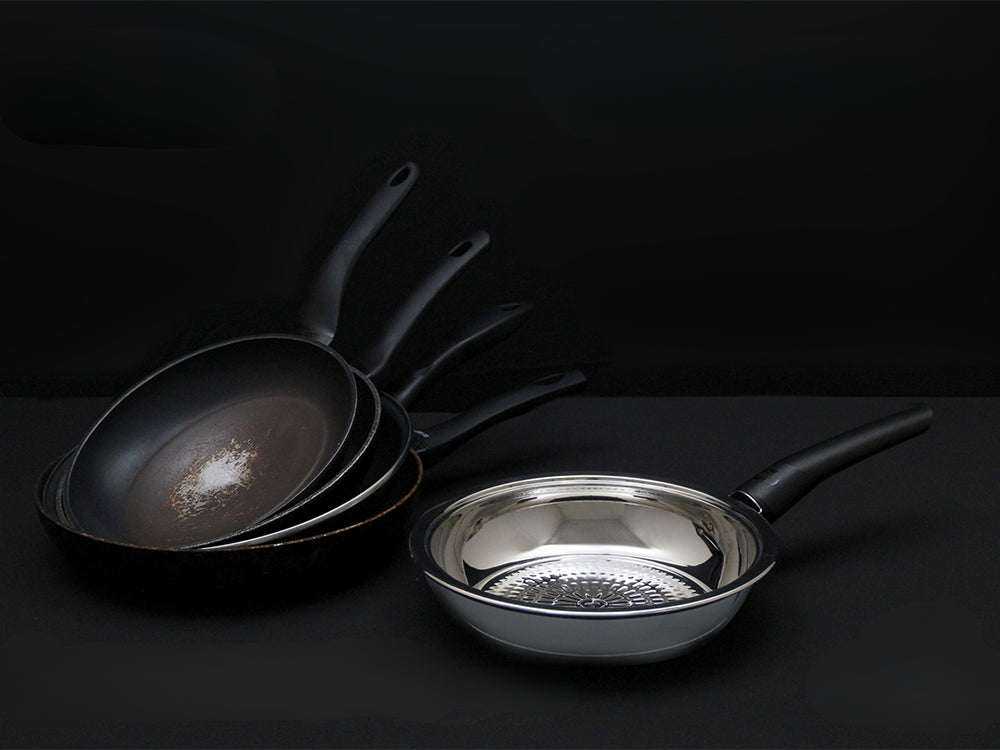
Unlike coated cookware, stainless steel does not have an additional surface layer that can gradually wear down, loosen or peel off through everyday use. Instead, the material provides a durable cooking surface designed for long-term use.
This is precisely the principle behind the AMC Cooking System. For more than 60 years, AMC has been developing pots and pans made from high-quality 18/10 stainless steel without relying on synthetic non-stick coatings.
It supports roasting and gentle cooking with targeted temperature and time guidance: food can be roasted with little or no added fat, and dishes can be cooked in the closed pot without added water. The temperature indicator in the lid shows when the right moment for each cooking step has been reached. This reduces uncertainty and makes everyday cooking more predictable.

Whether it is a quick weekday dinner, a meal for the whole family or a new recipe, AMC makes for relaxed and enjoyable cooking.
Are you looking for cookware without a synthetic non-stick coating? Discover how the AMC Cooking System combines high-quality stainless steel cookware with intelligent cooking technology.
Find out more about how uncoated cooking with AMC works on our page “Cooking Uncoated with AMC.”


Leave a comment
This site is protected by hCaptcha and the hCaptcha Privacy Policy and Terms of Service apply.